App Store fees for developers: everything Apple charges, in one place
A complete map of what an iOS developer pays Apple: the US$99 membership, 30% vs 15% commission, taxes, bank fees, refunds, and the regional rate changes.
 By Alexander, maker of Storewatch · · 6 min read
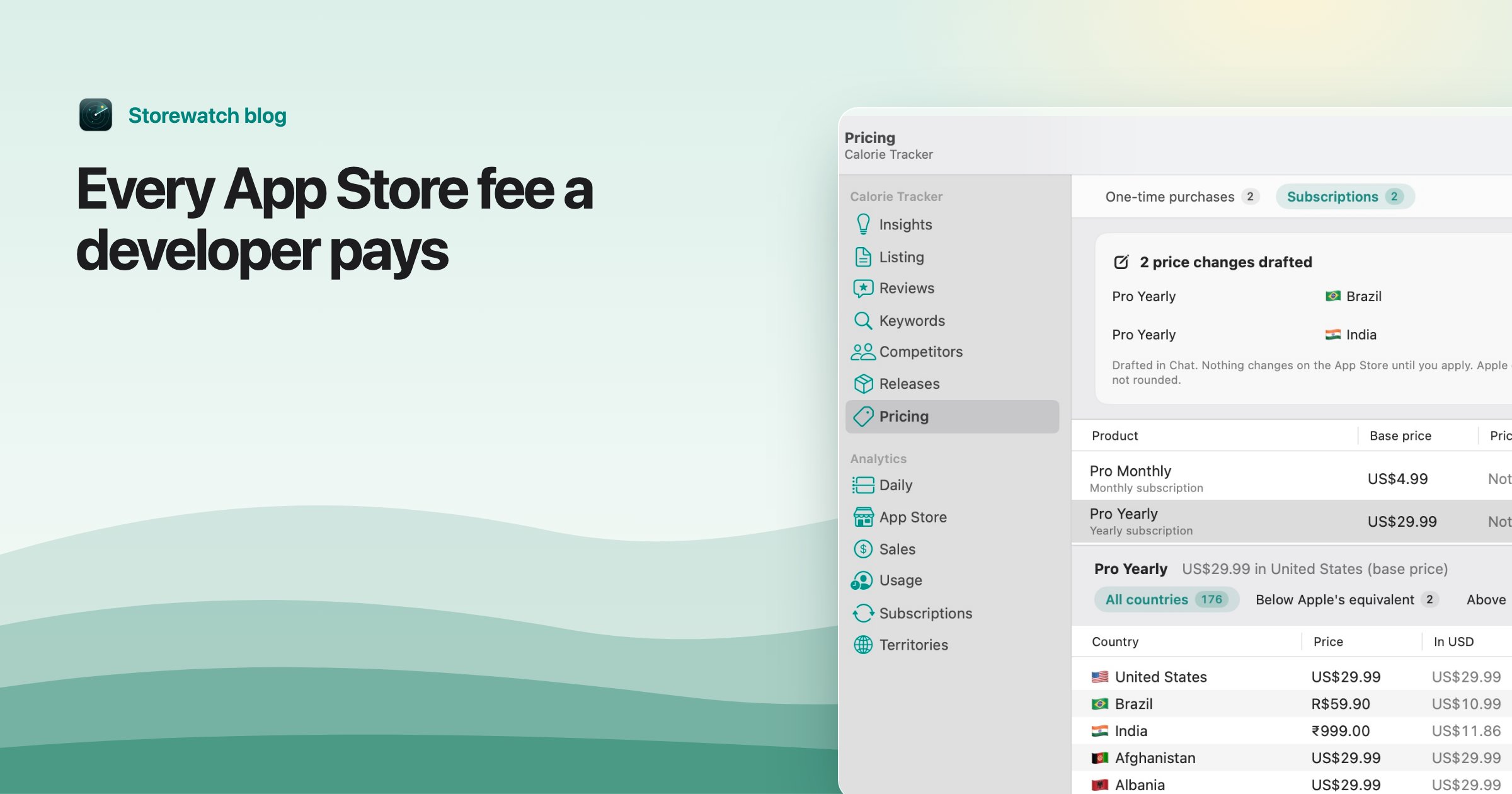
As an iOS developer you pay Apple two things directly: a US$99 yearly membership, and a commission on what you sell. The commission is 30% by default and 15% in several programs. Everything else people call an "App Store fee" is a tax, a bank charge or a regional rule, and this page maps all of them.
Rates here come from Apple's own pages and are accurate as of November 2026. Apple changes them by region, so each section links to the page to check before you rely on a number.
The fees at a glance
| Fee | How much | Who pays it | Details |
|---|---|---|---|
| Developer Program membership | US$99 per membership year (or local currency) | You, up front | Developer Program cost |
| Standard commission | 30% of sales of digital goods and services | You, deducted from each sale | Below |
| Small Business Program | 15% | You, if you qualify and enroll | Small Business Program guide |
| Subscriptions after one year | 15% (you receive 85%) | You, automatically | Below |
| Video / News Partner programs | 15% on qualifying sales | You, by application | Below |
| Sales taxes and VAT | Varies by country | The customer; Apple collects it | Below |
| Currency and bank fees | Varies by bank | You, on the payment | Why payouts differ |
| Regional rates | Differs in China, Taiwan, the EU, Japan and others | You, by storefront | Below |
Apple's membership page lists the 99 USD program fee and a commission on digital sales, and describes no other membership charges.
The Apple Developer Program fee
You pay US$99 per membership year, or the equivalent in local currency where available, and you need it to distribute on the App Store. Eligible nonprofits, accredited educational institutions and government entities can request a fee waiver. Free apps still need the membership. The full breakdown is in our Developer Program cost guide.
The standard commission
Apple's commission on the sale of digital goods and services through the App Store is 30%. It applies to paid apps and to In-App Purchases, including subscriptions in their first year.
The commission comes out of the price after taxes. What's left is your proceeds: the customer price minus applicable taxes and Apple's commission, as App Store Connect Help defines it. A US$4.99 sale with no tax yields US$3.49. With 20% VAT included in the price it's lower, because Apple removes the VAT first.
Reduced commission: 15%
- Small Business Program. 15% if your proceeds were up to US$1 million last calendar year and you enroll. Eligibility, the threshold, associated accounts and start dates are covered in the Small Business Program guide.
- Subscriptions after one year. You receive 70% of the price during a subscriber's first year of paid service and 85% after it, per Apple's subscriptions page. Free trials don't count toward the year.
- Video Partner Program. For apps whose main function is a premium video entertainment subscription, Apple's program page says members earn 85% of sales made through In-App Purchase. It requires a separate addendum and features like AirPlay support.
- News Partner Program. Apple's page says publishers working with Apple News may qualify for 15% on qualifying subscriptions from day one.
Apple's membership page also lists a Mini Apps Partner Program at 15%. Both partner programs are by application, so most indie developers will be on the standard rate or the Small Business Program.
Taxes Apple collects or withholds
The customer price includes any taxes Apple collects and remits, such as VAT or sales tax, and your proceeds exclude them. So tax isn't a fee you pay; it's the reason proceeds are smaller than the price on the shelf.
Some payments also carry withholding tax, which shows under "Taxes and Adjustments" in the payments report. Whether any applies depends on your country and the tax forms you give Apple (see Apple's tax information help). Apple's payments overview gives Nepal as one example of tax deducted by a local bank.
Currency conversion and bank fees
Apple pays within 45 days of the end of the fiscal month. Its bank converts the amount to your account currency, typically at the spot rate on the payment date or up to three business days before. Your bank, or an intermediary, may charge fees on the incoming transfer, and Apple says that reduces what's deposited. Those costs never appear in App Store Connect. Why your App Store payment doesn't match your proceeds goes through each one.
Refunds and free apps
Refunds. Apple's reports subtract refunds from units and sales, and Apple notes that refunds can be recorded at different times in the live dashboard and the finalized reports. A refund can therefore reduce a later month's figures rather than the month of the sale. I found no separate refund fee on Apple's help pages.
Free apps. Commission applies to sales, so an app with no paid download and no In-App Purchases generates no commission. The membership fee still applies, and to receive proceeds you need a Paid Apps Agreement in effect.
Regional rule changes, as of November 2026
Commission rates are not the same everywhere. These are the changes I could confirm on Apple's own pages; check each before relying on it.
- China mainland: from March 15, 2026 the standard rate is 25% and the reduced rate 12%, per Apple's announcement.
- Taiwan: from October 31, 2026 the standard rate is 26%, per Apple's announcement. It doesn't state reduced rates.
- European Union: new unified business terms took effect October 1, 2026 (announcement). Apple's EU page lists rates for In-App Purchase and alternative payments, and says the Initial Acquisition Fee and Store Services Fee are eliminated.
- Japan: with iOS 26.2 and later, alternative payments and marketplaces are allowed. Apple's Japan page lists a commission plus a separate payment processing fee for In-App Purchase.
- United States: on May 1, 2025 Apple updated its guidelines for a US court decision on buttons and external links on the US storefront. I found no Apple page setting a different US commission rate, and Apple's pages don't state whether linked-out purchases carry one, so confirm in the current agreement.
Apple's membership page also names Brazil, the Netherlands, Russia and South Korea as having different rates or fees for some apps.
How to pay less
Legitimate options are narrower than the search results suggest.
- Enroll in the Small Business Program if you're under the threshold. It's the biggest lever for most indies.
- Keep subscribers: after a year of paid service your rate drops to 15%.
- Check what applies in your storefronts. In some regions Apple allows other payment options, at their own rates.
Check each against the guidelines before building on it; an App Review rejection costs more than the commission.
Storewatch's analytics show proceeds by fiscal month and by account, so you can see what you actually keep after commission and tax. It's a Mac app; your data stays on your Mac.
Frequently asked questions
What does Apple charge developers?
US$99 per year for the Developer Program, plus a commission on digital sales. The commission is 30% by default and 15% in programs like the Small Business Program, or for subscriptions after year one. Rates differ in some regions.
Is the App Store commission 30% or 15%?
Both exist. 30% is standard. 15% applies to Small Business Program members, qualifying subscriptions after a subscriber's first year, and partner programs.
Does Apple charge for free apps?
No commission applies if you sell nothing, but you still need the US$99 membership to publish.
Who pays the VAT on App Store sales?
The customer. Apple collects it, remits it where required and excludes it from your proceeds.
Why is my payment less than my proceeds?
Currency conversion, withholding tax, bank fees and fiscal timing. See our guide on payout vs proceeds.
Can I avoid App Store fees entirely?
The membership fee isn't avoidable. The commission applies to digital goods sold through the App Store, and the rules for alternatives vary by region, so check Apple's pages for your storefronts.