Your keyword ranks are probably wrong: public search vs the real App Store
Many rank trackers and scripts read keyword ranks from Apple's public iTunes Search API. I checked 48 keywords in 8 countries against the App Store's own search: in the US, UK, Canada and Australia they often disagree by dozens of places. The data, why, and what to do about it.
 By Alexander, maker of Storewatch · · 6 min read
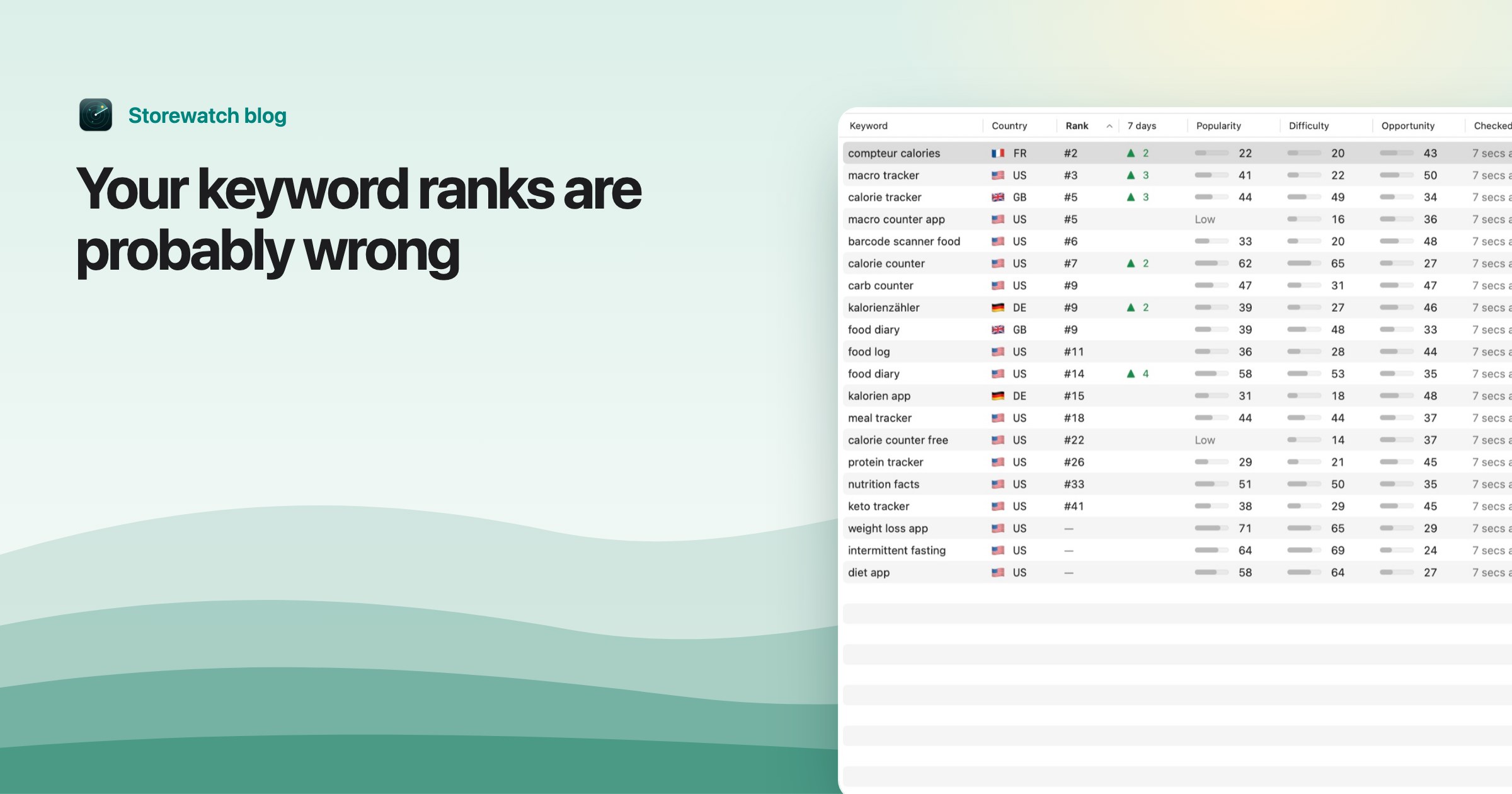
I track keyword ranks for my three apps every day. For a long time the numbers came from Apple's public search API, the same one most free rank checkers and home-made scripts use. Then I compared it with the App Store's own search for “cozy game” in the US. My tracker had my puzzle game at #41. The App Store had it at #237.
So I ran both searches side by side on 48 keywords in 8 countries, a few seconds apart. This post covers what I found, why the two searches differ, and how to read your ranks without fooling yourself.
There are two App Store searches
The public search API (itunes.apple.com/search) is the one Apple documents in its Search API guide, meant for finding content to link to. It's free, needs no account and returns up to 200 apps per search, so it's what most rank tools and tutorials use. To get a “rank”, they search a keyword and look for your app in the list.
The App Store's own search is what the App Store app shows people when they type a keyword on their iPhone, for each country's storefront. Apple doesn't document it or promise anything about it.
Both search the same apps. The question is whether they put them in the same order.
The test
On November 16, 2026, I took 48 keywords I track for my apps (a block puzzle game, a trip planner and a makeup expiration tracker), 6 per country in the United States, United Kingdom, Canada, Australia, Germany, France, Italy and Japan. For each, I ran both searches a few seconds apart, without signing in, and compared three things:
- whether the #1 app was the same,
- how many of the top 10 apps appeared in both top 10s (in any order),
- where my app ranked in each.
It's a small sample from three indie apps, not a study of the whole App Store. But the pattern was clear enough to change how I track ranks.
What I found
Across all 48 searches, the two agreed on the #1 app 35 times and shared, on average, 7.7 of their top 10 apps. That sounds close, until you split it by country:
| Country | Same #1 app | Top 10 shared (avg) |
|---|---|---|
| United States | 3 of 6 | 6.2 |
| United Kingdom | 4 of 6 | 5.3 |
| Canada | 2 of 6 | 6.3 |
| Australia | 4 of 6 | 7.5 |
| Japan | 4 of 6 | 7.3 |
| Germany | 6 of 6 | 9.8 |
| France | 6 of 6 | 9.3 |
| Italy | 6 of 6 | 10 |
In Germany, France and Italy the two searches were nearly identical. In the United States, United Kingdom, Canada and Australia, half the time a different app was #1, and around 4 of the top 10 were different apps.
Where my apps ranked
My apps were in the top 200 of at least one search for 21 of the 48 keywords. The rest are long shots, which is normal for small apps. Here are the ones outside Germany, France and Italy:
| Keyword | Country | Public | App Store |
|---|---|---|---|
| cozy game | US | #41 | #237 |
| makeup expiration | US | #22 | #141 |
| boredom | US | Not in top 200 | #61 |
| shelfie | UK | #14 | #29 |
| makeup expiration | UK | #1 | #2 |
| calm island | UK | #119 | #87 |
| chill puzzle | Canada | #65 | #73 |
| daily block puzzle | Canada | #155 | Not found |
| cozy puzzle | Canada | #124 | Not found |
| weekend getaway | Canada | Not in top 200 | #158 |
| cozy block puzzle | Australia | #2 | #6 |
| block puzzle | Australia | Not in top 200 | #170 |
| 無課金 パズル | Japan | #17 | #15 |
| 通信なし ゲーム | Japan | #68 | #53 |
In the English-speaking stores, every keyword where my app showed up in both searches had a different rank, and in 6 of 7 the public search put it higher, twice by more than 100 places. Six more keywords showed my app in one search and not the other. In Italy, all five keywords where my app ranked had exactly the same rank in both.
The gaps that matter most are the ones that cross a line you care about: #2 vs #6 is the difference between the first screen and a scroll, and #22 vs #141 is the difference between “almost there” and “nowhere”.
Why they disagree
Apple doesn't explain how either search ranks apps, so this part is what the data suggests, not something Apple has confirmed:
- They're ranked separately. The same apps show up, but in a different order, and the gap grows the further you go down the list.
- The public search stops at 200. The App Store's search goes further, so a rank of #237 simply can't exist in the public search. Your app just looks “not ranked”.
- Some countries agree more than others. Germany, France and Italy matched almost exactly, with the same #1 app every time. The English-speaking stores differed most, with Japan in between. I don't know why, and it may change.
What this means for your ranks
Treat public-search ranks as a rough guide
If your tracker reads from the public search, its ranks are an estimate of what people see. In the English-speaking stores in my test they were usually better than the real ones; in Germany, France and Italy they were spot on. Decisions like “we're #30 for this keyword, let's push it into the top 10” deserve a check against the App Store itself.
Compare like with like
A rank from one search and a rank from the other aren't comparable. If your tool switches source, or you compare two tools that use different sources, you'll see big “moves” that never happened. Only trust a change when both days come from the same search.
Look at the trend, then spot-check
The direction of a keyword over a few weeks tells you more than any single day's number. Every so often, search your most important keywords in the App Store app yourself. Keep in mind that the first result there can be an Apple Ads ad, which isn't part of the ranking.
Watch the top 10
Few people scroll far. Moving from #180 to #120 is nice to see but rarely changes your downloads; moving from #14 to #6 usually does. Spend your effort on keywords where you're close to the top.
How Storewatch checks ranks now
This test is why Storewatch 3.0 reads ranks from the App Store's own search in each country, once a day, instead of the public API. If the App Store's search can't be reached, it falls back to the public search and labels those ranks, and it never reports a move between two days that came from different searches.
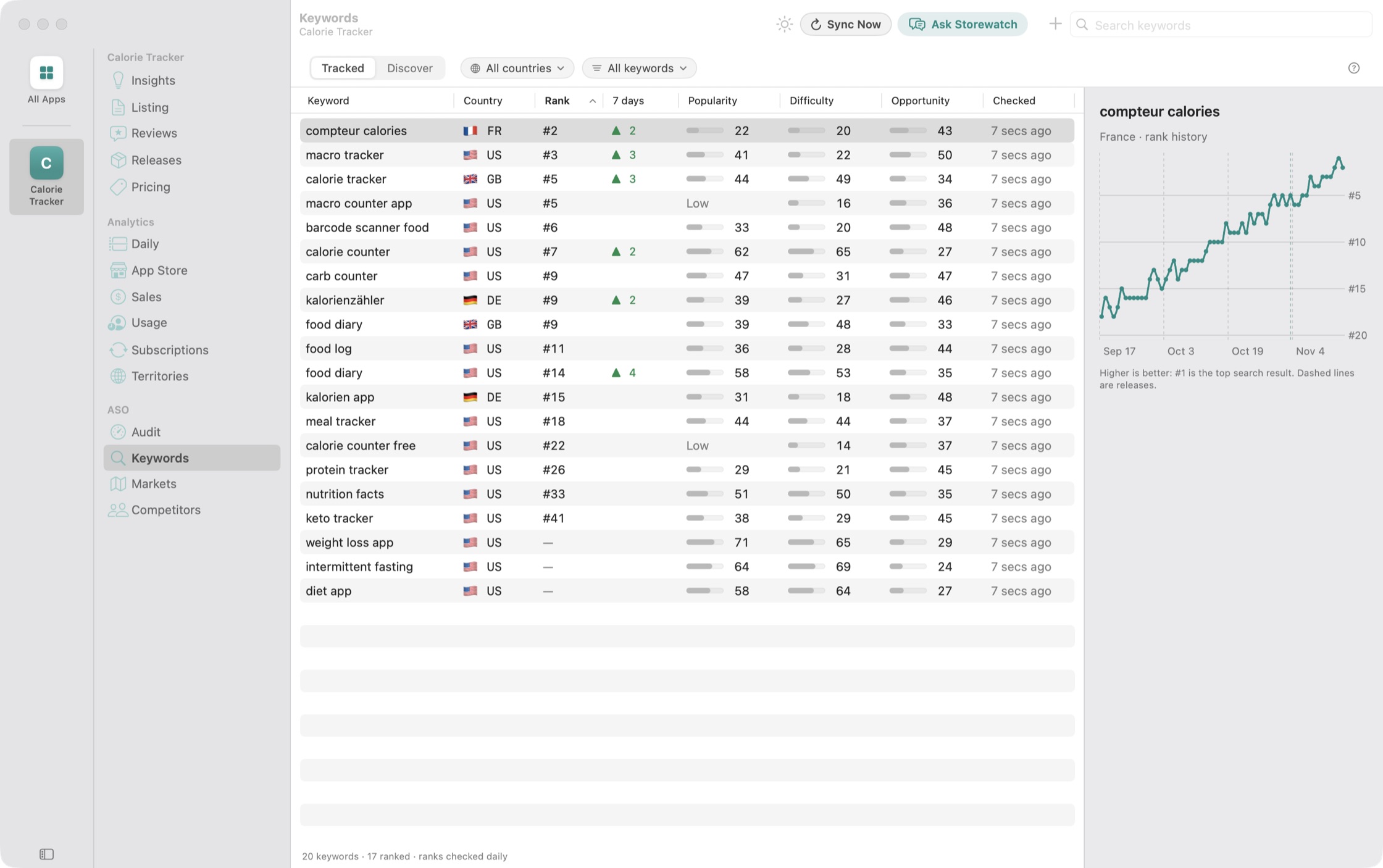
Rank checks run on your Mac and use no AI credits. Connect a free Apple Ads account and each keyword also gets Apple's own popularity score.
Frequently asked questions
Is the iTunes Search API wrong?
No. It does what Apple documents it for: finding apps and other content to link to. It just isn't the search people use in the App Store app, and it orders results differently, so it's a poor stand-in for keyword ranks.
How many results does the public search return?
Up to 200 per search. If your app is further down than that, a tool using it will show you as not ranked.
Will my iPhone show exactly the same order as the App Store's search?
Close to it, but not always. The top result can be an Apple Ads ad, results can shift during the day, and Apple doesn't say whether search is personalized. Use your phone for spot checks, not as a daily tracker.
Why did my rank jump when I changed rank trackers?
Most likely because the new tool reads a different search than the old one. Compare ranks only within the same tool, and give a new one a few days to build its own history.
How often should I check keyword ranks?
Once a day is plenty. Ranks move with downloads, ratings and listing changes, and day-to-day noise is normal. Look at the trend over a week or more.